To spread the original, universal and eternal truth, path or law of yoga, which remains forever the same in essence, yet always adapts to the time and place.
|
To spread the original, universal and eternal truth, path or law of yoga, which remains forever the same in essence, yet always adapts to the time and place. |
|
Book details : see Leela
Review by the "New Age Retailer", March/April 1994 :
 If
Indian / Hindu religion, culture, philosophy, history, spirituality
in general, or the history of gaming or sacred games is of interest
to you, you will not be disappointed by this book. It is actually
part of a boxed game set with a board and die on which one works
out past, present, and future karma.
If
Indian / Hindu religion, culture, philosophy, history, spirituality
in general, or the history of gaming or sacred games is of interest
to you, you will not be disappointed by this book. It is actually
part of a boxed game set with a board and die on which one works
out past, present, and future karma.
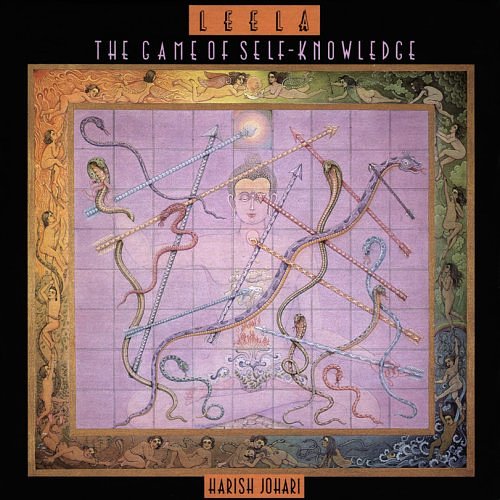
However, this is a lot more than the run-of-the-mill description/ instruction pamphlet-booklet usually encountered in these cases. Rather, it is an amazing work concerning not only Indian religious culture/belief/philosophy, but a singular description of the soul's progress along the path to enlightenment and wining the game. It gives a very in-depth, beautiful, and deep, thought-stirring description of each level of consciousness, which is represented on the game board as squares by different names, and influenced, by the placement of the snakes and arrows which are depicted on the board. Just studying the board itself is a life's work.Playing the game is another life's work. Understanding the seventy-two commentaries, arranged in rows which correspond to the chakras, is going to take a lifetime as well.
This is the game of gods, kings, sages, philosophers. It is extremely ancient, simple yet really quite complex. Which end of the spectrum it leans toward depends on the players involved and their level of spiritual enlightenment and awareness. Each row of spaces, representing a level of human consciousness or plane of being, is covered in a separate chapter describing the various steps along, into, up to, and out of that particular plane of consciousness and spiritual development. Each player uses an object which is personal in nature, such as a ring, to move along the board. It is said that by playing over and over, one can tell, by the areas one continually gravitates to and the patterns which the die throws take, the level of one's spiritual being, one's past, and future spiritual development as well.
The game was originally called Gyan Chaupad, and provides keys to understanding of the knowledge of the Vedas, the Shrutis, the Smiritis, and the Puranas. "…Playing the game is playing with the manifested divine knowledge found in the aphorisms and doctrines of yoga, of Vedanta, and samkhya, which flows in the body of the Hindu tradition of philosophy and lifestyle…..After a few minutes of playing, the game board starts to play with the mind and intellect of the player as well as the ego, and the strong sense of self-identity, the 'isness' of the player." The author goes on to state that the influences in the formulation of the game point to an age of about 2000 years and the copy he used to put this version together is 1500 years old. He also states that a book of chants containing "schlokas" originally accompanied the game board, with the player reciting or chanting the appropriate one for the square he had just landed on. This has been long since lost, making this book of commentaries necessary.
In a way, it is a blessing, though it would be wonderful to have the original accompaniment of the chants intended for each square, we now have also Johari's commentaries, which in themselves are a spellbinding web of spiritual and practical reflections on the various stages of development and which is absolutely fascinating on its own, even without the game. Johari is practical too, as well as spiritual, and gives some insights and explanations that are priceless and simply not to be surpassed, or found elsewhere. His approach to enlightenment, life, and spiritual growth and development are totally unique, and he has a very simple, yet poetically lovely way of expressing them.
I don't think anyone with an interest in Indian culture on any level will be disappointed in this book. If you have a common area for sitting around and relaxing, you might want to place this game and book out for customers to become fascinated with. This could prove to be one of the most unusual and truly enlightenment experiences of your life.
 Guru Brahma, Guru Vishnu, Guru Devo Maheshwara, Guru Saksat Parabrahma, Tasmae Shri Guruve Namaha
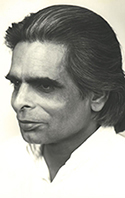 Sanatan Society is an international networking association of students of the late Harish Johari, joining efforts to promote his teachings of yoga philosophy, tantra, worship, art and love. Sanatan Society stands
for the original, universal and eternal truth, path or law of yoga.
Though it is Hindu in origin, Sanatan Society is not limited to any religion,
race, time or country, nor in fact to any particular organisation. More about Sanatan Society...
Sanatan Society is an international networking association of students of the late Harish Johari, joining efforts to promote his teachings of yoga philosophy, tantra, worship, art and love. Sanatan Society stands
for the original, universal and eternal truth, path or law of yoga.
Though it is Hindu in origin, Sanatan Society is not limited to any religion,
race, time or country, nor in fact to any particular organisation. More about Sanatan Society...